Pages

Tuesday, May 27, 2014

Perspective Your Computer Can't Do


A background for a piece I'm working on. So multiple vanishing points that don't match up, curvilinear perspective that kind of torques as it turns around. This perspective is done intuitively without rulers. It is technically wrong, but makes intuitive sense.

Computers Aren't Always Your Best Perspective Friends

I think a lot of illustrators these days are relying on 3D modeling programs for their perspective, and while Manga Studio doesn't do your perspective for you, it has a perspective tool that definitely helps. You still have to know perspective to use these tools effectively if you're going to use them in conjunction with 2D imagery. But sometimes it can look just a little too perfect. A little too geometric. 

We have stereoscopic vision.  Looking at a 2-dimensional image is always going to be like looking at the world through a telescope. I think this kind of distortion isn't always going to be appropriate for what you're trying to achieve with an image, but it does reflect a certain aspect of how we see.

3D Virtual Spaces vs. 2D Illusionistic Spaces

Someone on Facebook asked me recently why I thought we saw things differently in 3D vs.2D. This made me think of 3D animation vs. 2D and the fundamental differences between them.

It's all about depth perception. Two dimensional images have no depth, just the illusion of depth, as if seen from a fixed point. Drawing from life or imagination, you can provide more depth to your images, since you're able to elaborate on the information, exaggerating some of the dimensional aspects of the image, not just obvious distortions, but subtle stuff, like light and shadow, aspects of the picture that a photo couldn't capture.

Much like photography and cinematography, CGI is also very literal in its interpretation of 3D objects. It's a virtual space that complies to many of the essential rules of physics. While the physics of movement is easier to manipulate and exaggerate in a CGI environment, is't not so easy to manipulate the physics of the virtual space itself. Even if distortions are made in the virtual objects that occupy the space, once the camera pans around the object it's very much like a sculpture or three-dimensional object and follows all the conventional rules of how we see objects in a traditional 3-dimensional space.

This is most evident when 3D objects are introduced into 2D animation. There can be a sometimes jarring dissonance between the two. The two approaches create a collage effect. Sometimes this works out. Sometimes it doesn't. 2D animation has such a distinct look because of the unique spacial relationships that can only be achieved with organic and intuitive distortions of 2D imagery.

What About 3D Movies?

That's an illusion, based on the way your eyes combine the two images, but is not truly 3 dimensional. In 3D movies, this illusion is further exaggerated, and with these new cameras that can record stereoscopically they've really perfected it, but it's still an illusion based on two, two-dimensional images. Unless the images track the movement of your eye and point of view, and the images are coordinated with that movement, as in truly immersive virtual environments, you're not truly seeing in three dimensions. And they can't do that in a theater.

Sorry Steven Spielberg, but 3D movies are not the future of cinema. People will likely abandon theaters once they can get a 360 degree virtual view of the world in their homes. Even 2D movies look just as good when you have a virtual giant screen.


Monday, May 19, 2014

Appearances And Signings This Weekend In Davis!


The Avid Reader

May 24th, 1pm to 3pm

Signing and Giveaways

617 2nd St, Davis, CA 95616
(530) 758-4040


The Pence Gallery 


For the evening presentation I talk about how I was able to raise money for the publication of my book through a successful campaign on the crowdfunding site, Kickstarter, my work for Cricket Magazine and how I got started in children’s media. There will also be a live drawing demo. The kid’s presentation includes a drawing activity and instruction.


May 25th

212 D. Street, Davis CA
(530) 758-3370 

For kids ages 4-8 
1 to 2pm 

Family and all ages 
3 to 4pm 

$5 admission fee for each Pence event

Thursday, May 15, 2014

Appearing This Saturday at Bizarro Word!


I'll be appearing at Bizarro World in Davis CA at 223 E. Street at 12 to 2pm, Saturday the 17th for a signing and the official release party for my new book, (Mostly) Wordless! Refreshments, Giveaways, and More!

Insert Your Own Hair Related Pun Here.

A 3 inch by 3 inch commission.


(Mostly) Wordless Needs Your Help!


So all the books and premiums went out in the mail for the Kickstarter supporters, and everyone should have everything they're supposed to get. If you didn't get what you were supposed to get, please let me know and we'll fix it! 

But we're still having trouble getting (Mostly) Wordless out to the rest of the world. So I need your help to get the word out and to help us get into bookstores and libraries. Here's what you can do:


Review Us On Goodreads!


Since the book has yet to be released on Amazon (but it is still available for pre-order!) unfortunately you can't leave a review on their site just yet. But you can leave a review on Goodreads. So if you like the book, it would help a lot if you could leave a review. You can also reccommend the book to your friends on Goodreads. You have to be signed up to Goodreads to leave a review, so if you're not yet signed up, it's pretty easy, and free.


Where Can People Buy The Book?


Though a number of books went out to comics shops, we're having a hard time right now getting the book into bookstores and libraries. First: they don't know it exists yet since it hasn't had much promotion. The other problem is that they can't get it from their usual distributor. We were disheartened to find out that when bookstores tried to order from the largest U.S. book distributor, Ingram, their orders were cancelled. Even comics shops were unable to re-order the book. Our distributor, the distributor that Ingram is supposed to get our book from, is no longer willing to carry it, even though they sold out of every book they ordered from us. There are all kinds of strange reasons for this that aren't really worth going into, but this puts us in a little bit of a fix.
So Here's Where You Can Find it:

Amazon

While the official release date for the book on Amazon is supposed to be May the 13th, it will take a few weeks before orders will be filled. But you can still pre-order!

Baker and Taylor

If your local bookstore says they can't get it from Ingram, ask if they've tried Baker and Taylor. This is another distributor that should be able to get the book.

Last Gasp

If your local comic shop says they can't get the book, tell them they can get it from the distributor, Last Gasp. most comics shops use this distributor, and Last Gasp has been very reliable for us.

Alternative Comics

The book will always be available from the Alternative Comics retail site, Wow Cool. Status updates and reviews are also posted on the book's official page on their site.
Ask For It At Your Local Library

They can get it through Amazon or any other of the above options! Updates as things develop! 

Thanks everyone, and I'm sorry about all these inconveniences. It's harder to get a book distributed than I thought!

Wednesday, May 14, 2014

Drawing Little Nemo


So Locust Moon is putting together an Giant oversized anthology featuring different cartoonists doing their versions of Winsor McCay's classic strip, Little Nemo in Slumberland called Dream Another Dream.

Winsor McCay is one of my greatest influences. Little Nemo is one of my favorite things in the world. 

When I discovered this my immediate reaction was first jealousy, then envy. I wanted to be in that book. I SHOULD be in that book. Then I saw all the beautiful work being done for the book. Work from some of my favorite cartoonists and illustrators. Like Tantalus looking at his own reflection, I wanted to be there. I wanted to eat this stuff. 

On Facebook I was discussing the book with the amazing Carla Speed McNeil who was going to do a page for the book. I expressed to her both my admiration for what I was sure would be some fantastic work from Carla, and my naked envy for the project. I said that I wished I had the kind of reputation and track record that would have gotten me an invite to do something like this. Carla said that was just silly. They'd love my work. She said it was probably too late, but she'd put in a word. 

Shortly thereafter, Chris Stevens from Locust Moon contacted me. 

It was too late. 

But they were putting together a collection of prints of work that couldn't make it in the book for whatever reason, and that I was welcome to submit a piece. I told him that if I were going to do it, it would have to be something that could stand up well against any of the other work in the book, or it wouldn't be worth doing, and this would take time, and I couldn't guarantee that I'd have it done in time for a print. This may still be the case. In the meantime, here it is:


You're going to want to click to enlarge. It's pretty gigantic.

I think I kicked this one's ass.

But it turns out McCay beat me to it. I must have seen this some time in the past and unconsciously picked up on it. Oh well.


But I think I put my own little twist on things, so I'm content with what I ended up with.

And here's the original line art:


For anyone who knows my working method, I did this in pieces much larger than print size. The water and spout was done about 20"x30". Here's a few figures:


For some reason I just couldn't get the logo to look right, so I ended up tracing it in Illustrator, changing a few things here and there:


I had a great time.

UPDATE: Soon to be a print from Locust Moon!

Thursday, May 08, 2014

Nemo in progress

A small peak at much bigger piece. I missed the boat on the giant Nemo book, I'm afraid. The fate of this one depends on when I get it done. Best case, it will be some kind of print.


Tuesday, May 06, 2014

Mermaid, For a Larger Work


Been experimenting more with splatters and scumbluing.

Sunday, May 04, 2014

We're Living in a Golden Age of Comics and We Don't Even Seem to Realize It (lots of links)

OK. It's time to stop complaining about the state of the comics industry and take inventory of what we have.

First: lets move away from the word "industry" for a moment. Lets replace it with the word, "movement." Notice how, once we stop talking about comics as a commercial enterprise, everything changes. Something magical happens. We start talking about the comics we love. What's being created and rediscovered right now. And if we're going to talk about comics as a movement, instead of an industry, it's impossible not to acknowledge that there isn't a single time in history when there has been this many great and diverse comics available to us.

From the  resurgence of micro press books or zines,


with conventions like Stumptown and Zinefest, Mocca, The Small Press Comics Expo and many more,


to massive hardbound collections of  golden age comics and strips.


Japanese and a growing number of European imports have also been spreading in popularity, including a resurgence of kid's comics which have been absent from the market entirely too long.  


Despite distribution monopolies pushing out the little guy, great comics keep surviving and thriving. Non-genre books, genre books, too many to count. And of course, as in all media, most of it isn't that great. But a lot of it is. For the first time in decades, if I want to turn someone on to comics, I have a true library to recommend just as I would in any other medium. And now Comics are critically regarded in a way that they never have been before.

Webcomics are huge, and may end up becoming the default way to serialize comics, but handmade zines still have currency. You can't mass-produce the silkscreen covers and just plain care that goes into the books produced by micro publishers, so no matter how prevalent web comics become (which is not a bad thing at all) small press comics still have a niche.

Hundreds of great comics are being supported by Kickstarter and other crowdfunding sites. books that wouldn't exist otherwise, including my own, (Mostly) Wordless (now available on Amazon for pre-order, wide release on the 14th).

Shameless Plug

Dudes, buy my book!
 
Comics Exist in a Unique Bubble Where Academic Acceptance Doesn't Matter 
(At Least, Not That Much)

And of course distribution continues to be a problem.  Some of the best comics just aren't being seen by the public at large. There are few publishers willing to take a risk on comics with less conventional content. 

But in some ways this is a benefit. People are making comics because they need to make comics, not just because they think they can sell them, a phenomenon that just wasn't happening, at least not like this, in the 80s when I started reading comics. This means many comics creators have modest, or little commercial aspiration. Many comics are made for small audiences for the craft and art of making comics alone.

Cartoonists have to hustle to sell their books on their own at shows and conventions for little financial reward. But these comics are being made for the love of the medium. Since there isn't a structure in place to support these comics in the same way that other mediums are supported, it's the only medium right now where creators aren't likely to get rich from popularity or critical attention. Comics in a unique bubble where academic recognition and art world or literary success is not a big motivator. Grants and gallery exhibitions are rare. Even the mainstream media reviews we see often reflect a fundamental lack of understanding of the mechanics and history of the medium. So these cartoonists create for the benefit and enjoyment of diehard fans. I can't think of another medium where this is the case. The result is a purity of vision and lack of pretension that you just don't see in fine art and literature.

While cartooning schools are emerging with more of an academic bent, like SAW and The Center for Cartoon Studies, they still don't carry the creatively inhibiting baggage of hundreds of years of academic analysis.

 But this isn't going to last. Comics are starting to creep into the academic world with all its influences and pretensions. And it's becoming less and less feasible and practical to publish the kinds of lavishly produced books and reprint collections we're seeing now as digital is more popularly accepted as an economical and practical means of consuming media.

So it's time to start appreciating what we have while we have it. Because we're in the midst of a comics renaissance like never before, and things aren't going to be the same for very much longer. Mind you, I don't think it's going to get worse, it just won't be the same. There will be more comics, and good, and even great comics, but as with other progressive movements like modernism, there's only so much formal invention and truly innovative content that can happen within this short and fertile period while this very young medium remains largely unobserved.

Friday, May 02, 2014

Lobster Image for a Larger Work

I know I haven't been posting much, but I have some little projects and big projects in the works, and have been doing what I can to promote my new book, (Mostly) Wordless (available for pre-order on Amazon, and you still might find it at your local comic book store before it's released for the book trade on teh 14th).

Here's something from a work in progress, a small part of a much bigger piece.


Friday, April 25, 2014

Usagi Yojimbo To Be Auctioned Soon by CAPS to Benefit Stan Sakai!


According to the CAPS website:

On Thursday, March 6, 2014, Southern California's CAPS, the Comic Art Professional Society, will launch an ongoing series of eBay auctions of original comic art. Its goal is to raise funds for medical care for Sharon Sakai, the wife of respected cartoonist and longtime CAPS member Stan Sakai, creator of the samurai rabbit USAGI YOJIMBO. Sharon has been battling a debilitating brain tumor for some time; after an extended hospital stay and convalescence, she is currently at home, but her condition requires 24-hour care and medicine that costs more than the Sakai's insurance covers. 100% of the proceeds of these auctions will go directly to Stan and Sharon Sakai to help pay their ongoing medical expenses.

I'm proud to be a part of the auction, and support one of the most important and enduring independent creators in the business, Stan Sakai!

The picture should go up for auction in a couple of weeks. I'll be sure to let you know when, as soon as I do. 

Tuesday, April 15, 2014

9x9in White Rabbit from Alice In Wonderland

So, this was for a commission that was meant to be 3in by 3in. I accidentally ended up making it 9x9. Argh!  Fortunately there's time to correct the mistake, but here it is:


I think I might have a home for it though. And here's the original sketch:

As usual, there are things I captured in the sketch, that I didn't in the finish, and things in the finish that the sketch doesn't capture. Either way, I don't think this is my definitive take on this particular character.  I'm still happy with it though!

Wednesday, April 02, 2014

Another Gingerbread Man Rough. The Fox Gets Foxy

So I figured it was past time I posted some art. I've been spending much of my time stuffing envelopes for my Kickstarter project lately, and fulfilling my other Kickstarter obligations, so here's some art from my Gingerbread Man project:


Tuesday, March 25, 2014

Why Pat Boyette's Korg: 70,000 B.C. Is One of the Greatest Comics of All Time


Pat Boyette is one of the great unsung heroes of comics.

 Boyette's best known work is from Warren's Creepy and Eerie magazines and  the much maligned, Charlton, and Charlton is where he did one of the greatest comics of all time, Korg: 70,000 BC. Charlton was a company from Derby Connecticut that printed their comics on the cheapest paper with the cheapest coloring on their own presses, and notoriously paid their talent the lowest rates. But Charlton also offered its talent more creative freedom than they could get just about anywhere else, and artists like Steve Ditko and Pat Boyette were largely left alone to do what they wanted.

Boyette made up for Charlton's cheap page rates by producing a ton of work, working on numerous Charlton titles at once during the late 60s and 70s. He did everything, soup to nuts: pencils,inks, letters and sometimes scripts and fully painted covers. He famously did a complete issue of Peter Cannon, Thunderbolt in under a week. Sometimes, as a result, his work could look rushed, but at Charlton Boyette was given free reign to do some of the most formally experimental work of that era, on a book that nobody cared about. Korg: 10,000 BC, based on a pretty awful short-lived TV series. But Boyette made Korg his own.

Here's one of Boyette's typical painted covers:


Korg wasn't exactly great literature. Yes it looks kind of trashy. And this is the problem with a lot of comics, particularly from the past: some of the best storytelling wasn't always in the service of the best stories.

 But dismiss Korg at your own peril! If you're into comics, you should be into Korg. Why? Because of stuff like this:


This page is all diagonals and reads, not from left to right, but clockwise. Who does that?

Or this page:


Since Boyette did his own lettering (a rare thing in newstand comics at the time) he was able to use word balloons to guide the eye from left to right and then right to left again. but check out that second panel: 


Not only does the action go from right to left, but so does time. The guy on the right throws the spear, and then the middle guy says, "look out!"  But that's not the cool part!


 He switches the action seamlessly because the arrow is launched between panels, carrying us from left to right again. We don't see the arrow being shot, but the implication of the direction of the arrow changes the direction of the action. He emphasizes this forward momentum by having the stricken character lunge into the next panel.

This page looks to be shot from the original artwork, so you can see the art in it's original black and white, before Charlton coloring and bad printing had a chance to dull Boyette's line.


This one's a little more confusing. Now we have three panels. As the two men are attacked, we see a full figure shot of  one and a reaction shot of the other, each panel a kind of montage, with the last image in the second panel a reaction shot of the first as he struggles with the rope around his neck. At least I assume it's the first guy. Since they both look exactly the same, the rope is the only way we can tell one from the other. In the last panel, the action is joined together in one scene, and you have this sense that the action all happened very quickly, maybe even simultaneously.

I don't think this page entirely works, but it's still very ballsy, and typical of the kind of invention that you see again and again in Korg. Not every experiment worked, but nobody was trying this stuff, and Charlton was the perfect place to do it, because no one was watching. Boyette experimented with diagonals and other formal inventions in earlier stories, like Children of Doom from Charlton Premiere in the 60s:


(Back when the color printing was particularly bad) but never quite to the degree of Korg. 

Which is why Korg is one of the greatest comics of all time. Am I wrong?


Sunday, March 23, 2014

In Search of Moebius' Aedena Cycle in English Translation

For reasons I can't entirely understand, U.S. translations of the late Jean Giraud's alter ego are rare in the states. In the 80s and early 90s, there were a series of graphic novels released by Marvel Comics Epic imprint. This was how I was introduced to Moebius' work. This was the first of those to be released.


When I bought this at 14, I was immediately hooked. If you're familiar with Moebius' work, I don't have to tell you why. If you don't know, I recommend you Google him immediately. Other collections included short stories and longer works, classics like The Long Tomorrow (which inspired the look of the film, Bladerunner) and The Airtight Garage, an strip that was completely improvised in three and four page episodes, and continues to be one of my favorite works. But Upon a Star not only one was my first discovery of Moebius, but the first in a series called The Aedena Cycle that completely kicked ass.

Upon a Star was a commission done for the dealership of a car manufacturer called the Citroen, but eventually turned into one of his most enduring and personal works. The first three books of this series were easy enough to find  in the states when they were first released: Upon a Star, The Gardens of Aedena and The Goddess. After that the search became a little more difficult. 

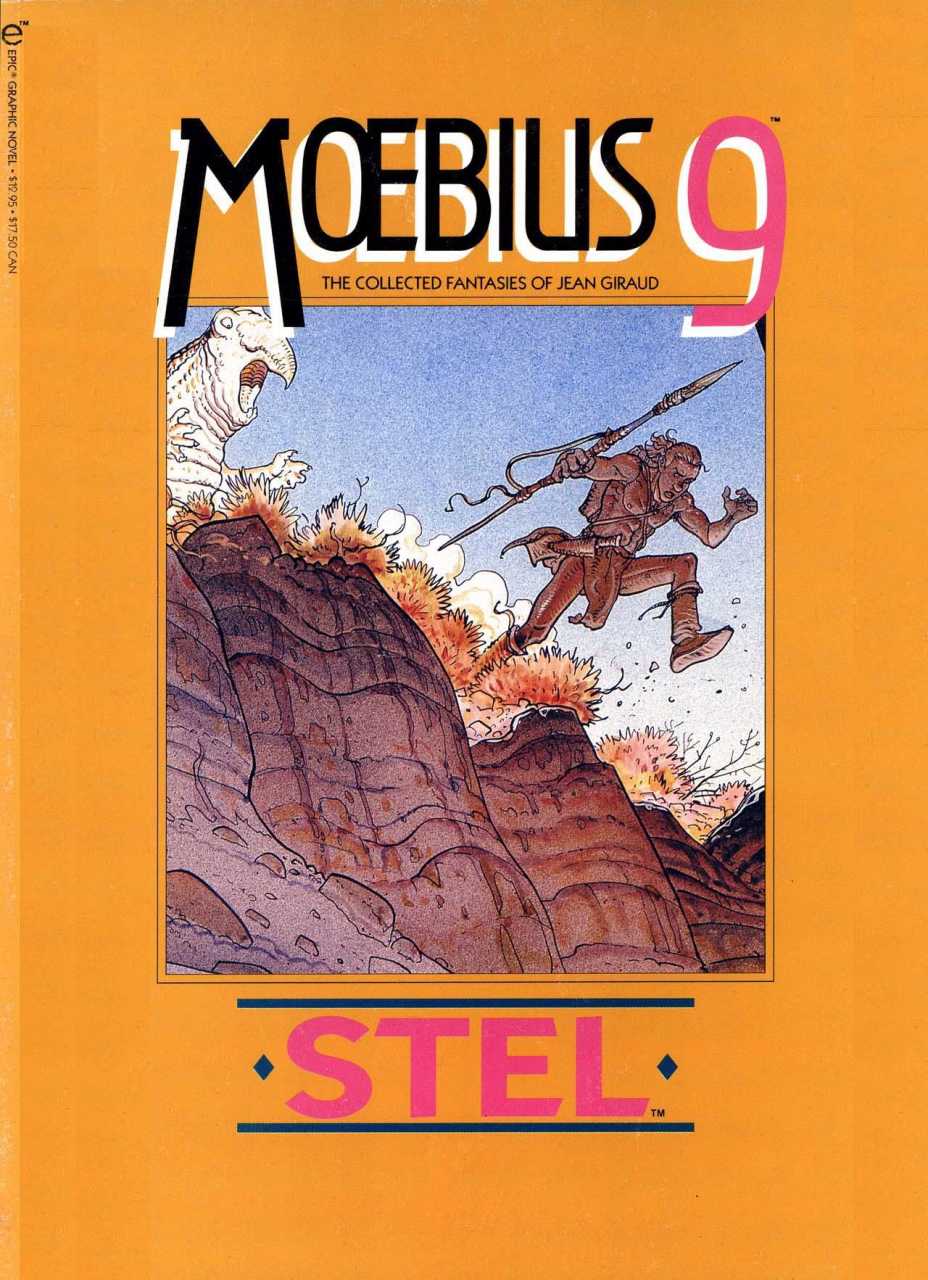
Stel was released in this now near impossible to find volume that I had the privilege of reading, but not owning a couple of years ago:


I think this was written when Giraud was just getting out of a a religious cult he had been involved in, and was unusually bleak for the series. 

The fifth wasn't reprinted at all, a book called,  Sra:


What I think is a  fan translated version is out there, or if it's not fan translated, it had a very limited run. The sixth had an even stranger release.


Concrete Earth Day, that featured a story done by Paul Chadwick about his signature character, Concrete, and a few others, included another story, a wordless story by Moebius.


So when recently I got the French version of the final Aedena book, Les Reparateurs,


I discovered that the story was very familar, most of it from the Earth Day book. Here are a few of the pages that were, for whatever reason, omitted in the reprinted story:


Part of me was a bit disappointed that I had seen the material before, part of me bewildered that it would be reprinted without any mention or acknowledgement that it was the final installment of the Aedena Cycle. Why had it been released with so little acknowledgement or fanfare? Moebius was still a big deal at the time.

While Moebius' collaboration with Jodorowsky, The Incal, has recently been reprinted for the U.S. Market, very little of his other work has seen English translation in recent years, including his very last album, A final story about one of his most iconic characters, Arzach.  For us Moebius fans, it's a bit daunting.

I lended out The Airtight Garage so often, that it's no longer in my possession, and these days, will cost me upwards of $100 to replace. There was a digest-sized sequel to the Airtight Garage released in the 90s by Dark Horse, but it seemed to be unfinished, and I'm wondering if it was ever continued.

Some day I'm sure there will be a beautiful hardbound collection of Moebius' complete works in English translation, but until then, unless you're willing to shell out hundreds of dollars, his work in translation remains hard to find. 


Friday, March 21, 2014

Cheetah Studies (Sans Spots)

Here are some more Cheetah studies for a commission I'm working on, just figuring out the anatomy. I didn't bother to put in the spots so they don't exactly look like Cheetahs, but you get the idea.


Tuesday, March 18, 2014

Why David Letterman Once Mattered: Satire on TV


Small town news on David Letterman, circa 1980 (at 3:26) the original internet content, irony provided by Dave.

 For better or worse, Letterman represented a sea change in mainstream media.

The Johnny Carson and Mike Douglas model offered straight Bob Hope and Borscht Belt inspired gags, and Letterman was the first to add a post-modern edge to the format. Political content was minimal and lacked the teeth of shows like Colbert and The Daily Show today, but Letterman was the original source of the tone of those shows, a wink to the audience that what they were watching was artifice. Unlike Saturday Night Live, (which by the early 80s was going through one of its worst periods) Letterman mocked the format itself and the fundamental fakeness of TV talk shows in the context of a TV talk show, something no one had done before. 

One convention of the format that Letterman hated was product endorsements, a mainstay of talkshows since their inception, segments in which the host would introduce whatever product the sponsor was selling. Even Mike Wallace shilled cigarettes.


But Letterman's ambivalence was apparent. I remember at one point seeing him walk out in the middle of one of these endorsements, refusing to continue. Eventually the network allowed him to stop altogether.

I remember as a kid being introduced to cartoonists like Harvey Pekar (who Letterman didn't really get) and Lynda Barry (who else would book a small press comics writer and cartoonist on a late night talk show?) Here he is interviewing Barry:


and the underrated Chris Elliot, a writer on the show who also helped to set the tone.


Letterman featured singularly unique guests and comedians who seldom appeared anywhere else, like Andy Kaufman and Brother Theodore. Brother Theodore would show up on the occasional Tonight Show episode, but he was a frequent guest on Letterman. The mainstream audience didn't have the patience for anything that wasn't Seinfeld style, gag a minute comedy, but Brother Theodore found a home on Letterman.

Here's Brother Theodore doing his thing:


For me, as a Kid, Letterman was my Mad Magazine. Mad Magazine was the original inspiration for Saturday Night Live and Letterman's brand of humor, but by the 80s had gotten into a kind of rut and had lost a lot of its former bite. Letterman had something new to say, or at least, a new way of saying it.

Letterman The Shill

Not that Letterman wasn't subject to the constraints and compromises involved in working for a show and  network whose main job was to sell soap and mouthwash and shill movies and TV shows with celebrity appearances. While subversive in its way, Late Night With David Letterman was still fundamentally a part of the corporate machine. When GE bought NBC, Harvey Pekar, in a now notorious appearance, took Letterman to task on this point, in affect, pulling down the curtain and revealing what Letterman's job truly was:


Letterman's anger here is personal. Letterman knows what his job requires him to do, and like his ambivalence about endorsing soap and mouth wash, he has some awareness that he's a passive actor in a larger high stakes game. He's owned by a corporation whose job is to sell junk.

Pekar revealed the failure and threshold of Letterman's ability to subvert, and I think he knew that what Pekar accused him of was fundamentally true. Lacking the charisma of Letterman (and with Letterman's own dismissal of Pekar as a guy who "writes comic books") nobody was listening. Pekar was considered a crank who had outstayed his welcome. He was no longer an amusing eccentric to serve as the butt of Letterman's jokes but an annoying nuisance.

Unfortunately many of these more oddball guests were treated as objects of ridicule by Letterman. They were lovable eccentrics, but "lovable" only went so far. Once again, Letterman gave a wink to the audience to say, "look at the freak show,"tolerating, but never fully embracing his guests who went just a little too far outside of the mainstream.

Now that every talk show on the air has adopted Letterman's ironic pose, this post-modern self-referential wink has lost any real irony or subversiveness it once had. Its been reduced to a trope, and The Late Show with David Letterman has blended into the background.


Steven Colbert as Heir Apparent

While Comedy Central's The Daily Show continues to be great satire, the most progressive talk show on the air is The Stephen Colbert Show which owes no less a debt to Letterman. Colbert has taken Letterman's knowing wink a step further. He presents a character whose every word is a lie. The subtext is the constant acknowledgement that all media is a lie. Using this character as vehicle, he's able to criticize the media in such a biting way that he would otherwise appear shrill and difficult to digest to a mainstream audience. But Colbert pulls it off smoothly and flawlessly, and his message is seldom lost on them.

As long as he's not selling something.

While on a certain level, Colbert's commercial endorsements, because of the inherent insincerity of his character, subvert their purpose, they're all too effective. Despite his pose, the audience's love for Colbert negates whatever intended irony or inherent insincerity lies in the pitch. In that moment he becomes the character he parodies, and is no less a celebrity pitchman.

This is the essential compromise that is commercial television.You can't bite the hand the feeds you. It's why, for the majority of its run, Mad Magazine, the grandfather of all media parody in this country, refused to accept advertisements. It was only after Bill Gaines sold the magazine to Warner Brothers and Gaines was long dead that ads began to run. Mad Magazine became a part of the corporate machine just like Letterman and Colbert. In the end, you can't be owned by GE or Warner Brothers, and you can't run endorsements for other products without compromising the very purpose of satire.

While the compromise is less glaring in Colbert, it's still there, and unfortunately, this is the only kind of satire that the mainstream public has an appetite for. You can only poke the corporate beast so hard. There's only so far that we'll allow our own contradictions to be revealed to us, especially when we're being entertained.